
What treatment aims to address
Personalized nose enhancement using implants, cartilage, or combined structural techniques, planned to improve facial balance while respecting your natural features.

Nose treatment
Personalized nose enhancement using implants, cartilage, or combined structural techniques, planned to improve facial balance while respecting your natural features.

Personalized nose enhancement using implants, cartilage, or combined structural techniques, planned to improve facial balance while respecting your natural features.
The outcome depends on your anatomy, health and healing. Discuss the expected change, limitations, alternatives and the option of no treatment with Dr. Bien before deciding.
Price, inclusions and additional costs → · Your first visit → · Plan work, travel and follow-up →
These are usual clinic estimates, not guaranteed recovery deadlines. Your procedure-specific instructions, healing and individual clearance take priority.
Your usual first review is around 2–3 days after surgery, followed by a visit around day 7 for stitch removal.
Follow-ups are included. Further visits are arranged according to your recovery.
Stitches are usually removed around day 7 when applicable. Follow the date given by your surgeon.
The usual estimate is around 2–3 days, depending on your procedure, comfort, work duties and your surgeon’s advice.
The usual estimate is around 2–4 weeks. Confirm clearance for the lifting, bending and exertion involved in your job.
Confirm these separately with your surgeon. Being ready for desk work does not mean you are cleared for exercise, driving or travel.
A companion is required for a sedated procedure. Arrange this before your treatment date.
Understand your estimate
Follow-up visits are included. Your visit schedule is confirmed as part of your individual care plan.
The ₱50,000–₱200,000 promotional range depends on the surgical technique, implant or graft material, anesthesia, and case complexity. Your selected plan determines the package price.
These are conditional extras, not automatic charges for every patient.
Confirm your total after assessment. Discuss the selected technique, materials, anesthesia, package inclusions, and any additional fees before deciding. Promotional rates apply to cash and online bank transfers; other payment methods may carry regular rates and applicable charges.
Real patient outcomes
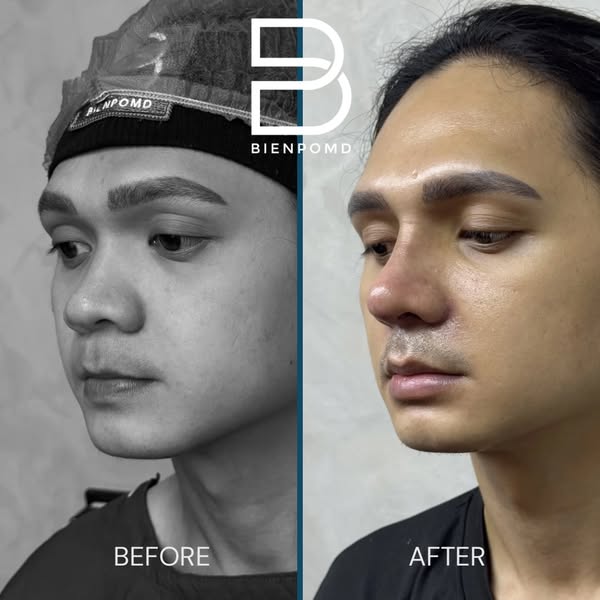
Browse every applicable before-and-after image published by BienPoMD for this procedure.
Rhinoplasty is not one implant fits all.The choice of nasal implant or graft material depends on anatomy, skin thickness, structural support, previous surgery, desired projection, and the amount of reconstruction required.
Gore-Tex is a brand name; ePTFE is the material.At BienPoMD, we commonly use ePTFE nasal implants from Surgiform and Implantech. These are separate brands, rather than Gore-Tex-branded products.
Silicone is a solid synthetic implant commonly used to augment the nasal bridge. Different shapes and degrees of firmness may be selected according to the desired contour and the patient’s anatomy.
Expanded polytetrafluoroethylene, commonly referred to as Gore-Tex or ePTFE, is a porous synthetic material used for nasal augmentation. Its microscopic structure allows some degree of tissue integration.
This approach combines structural support from irradiated rib cartilage with an acellular dermal matrix when clinically appropriate. Irradiated rib cartilage may support more complex bridge or tip reconstruction, while ADM may be used as a soft-tissue interface or coverage material according to the surgical plan.
No published patient case is currently available for this material.
Individual results vary. Lighting, angle, timing, anatomy, and healing can differ between cases. Images are educational and do not promise or guarantee a specific outcome.
Rhinoplasty is surgery that reshapes and supports the nose so it is better balanced with the rest of the face. At BienPoMD, augmentation rhinoplasty may use the patient’s own cartilage or a medical-grade implant such as silicone or expanded polytetrafluoroethylene (ePTFE, commonly called Gore-Tex).
The plan may address a low bridge, asymmetry, a wide or bulbous tip, weak structural support, or changes from an earlier procedure. Implant choice and surgical approach are individualized according to anatomy, skin thickness, support, previous treatments, and the patient’s goals.
Rhinoplasty may be considered for patients who:
An in-person examination is required. Breathing, skin and soft-tissue quality, cartilage support, natural asymmetry, previous fillers or threads, and realistic limitations must all be discussed before surgery is recommended.
Rhinoplasty is planned around facial proportions, skin thickness, bridge support, tip structure, breathing, and the patient’s own anatomy. Implant material and surgical approach are selected only after an in-person assessment; a smaller or higher nose is not automatically a more balanced result.
Recommended Videos
Short, patient-friendly explanations from Dr. Bien Po. Each link opens the original BienPoMD Facebook video.
 Why Rhinoplasty Is More Than Making the Nose Smaller
See how bridge support, tip structure, and facial balance shape a Rhinoplasty plan.
Watch Video ↗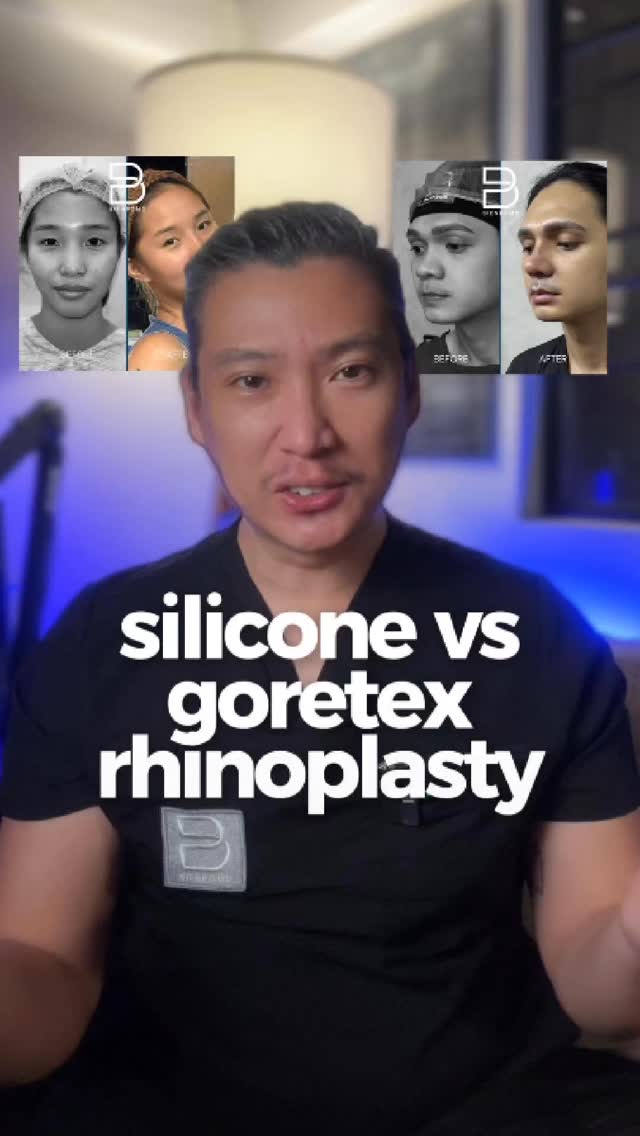 544K Views
Silicone Vs Gore-tex Rhinoplasty
544K Views
Silicone Vs Gore-tex Rhinoplasty
Understand why implant choice depends on anatomy, goals, and surgical planning.
Watch Video ↗ 151K Views
Unlimited retoke ng ilang celebrities.
151K Views
Unlimited retoke ng ilang celebrities.
Unlimited retoke ng ilang celebrities. #rhino #rhinoplasty
Watch Video ↗ Rib Rhinoplasty Explained
Learn what irradiated rib cartilage is and why it may be used for nasal support.
Watch Video ↗ 70K Views
Rhinoplasty Recovery Timeline
70K Views
Rhinoplasty Recovery Timeline
A practical look at swelling, healing stages, and when results begin to settle.
Watch Video ↗Patient experiences
Gore-Tex Rhinoplasty
I used to dislike taking my own photos, but after rhinoplasty I take photos every day.
Patient message shared by BienPoMD

Silicone Rhinoplasty
Hello po, Doc Bien. Seven months na po ’yung nose ko and I really love it po.
Seven-month patient update

Experiences and results vary.
Frequently asked questions
Implants and cartilage grafts are intended for long-term structural support, but no implant is maintenance-free or guaranteed to remain indefinitely. Infection, displacement, extrusion, trauma, or changing anatomy may require revision or removal.
The plan aims for proportionate refinement while preserving your identity. The achievable change depends on your anatomy and the selected technique.
Yes, when appropriate. Bridge, tip, and nostril-base concerns may be addressed in one plan after a full nasal assessment.
Visible swelling is expected during the first one to two weeks. Residual swelling, particularly around the tip, can continue for months. Bruising and healing vary.
Previous fillers or threads do not automatically rule out surgery, but they can make the case more complex. The material, timing, tissue condition, and need for removal must be assessed.
Often, yes. An additional revision fee of about ₱20,000–₱100,000 may apply depending on complexity. The final plan and total rate are confirmed after examination.
Meet Dr. Bien in person, discuss what concerns you, and receive an honest assessment of what may—or may not—be appropriate.
Third-Party Feature
Independent video content linked to its original publisher with visible source credit.
Medical context and authorship
Material-specific case
This case used an acellular dermal matrix (ADM) implant with irradiated homologous rib cartilage for selected bridge and structural needs, together with the patient's ear cartilage for tipplasty. Each material served a different role within one anatomy-led surgical plan.
ADM is processed dermal tissue with cellular components removed, leaving a collagen-rich framework that may be used for augmentation or contour coverage. Irradiated homologous costal cartilage is donor rib cartilage processed for implantation and may provide structural graft material without harvesting the patient's own rib. Ear cartilage remains useful for selected tip-shaping and support because of its natural curvature.
What the image can show
The four views document a one-week transformation after the combined procedure. At this stage, swelling, firmness, asymmetry, scar maturation, and tip definition are still changing. The comparison should not be interpreted as the settled outcome.
Safety in context
Published reviews report generally low complication rates for irradiated homologous rib cartilage, but infection, warping, resorption, displacement, extrusion, contour change, and revision remain possible. ADM studies also describe resorption and other complications. Product processing, surgical technique, tissue coverage, fixation, anatomy, and follow-up matter.
Read the evidence-based Library guide →