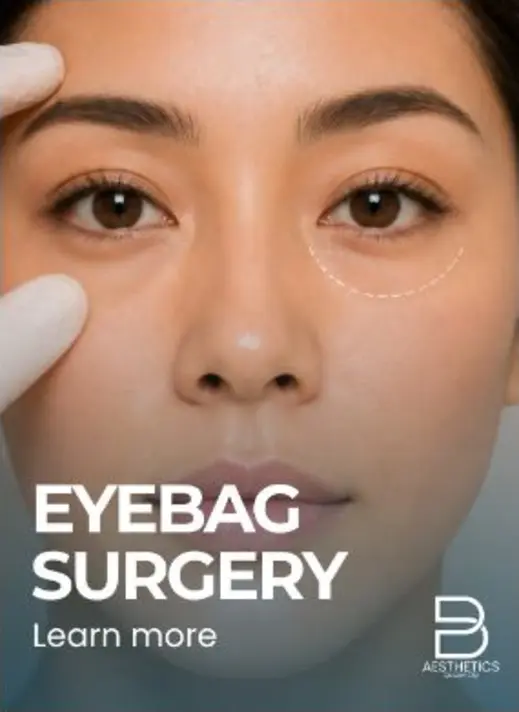
Prominent fat pads
Forward fullness may be treated by carefully removing or repositioning selected lower-eyelid fat.
BienPoMD Aesthetics
Lower eyelid surgery
A surgical approach for selected patients with prominent lower-eyelid fat, contour irregularity, or structural changes contributing to a persistently tired appearance.
At a glance
Final recommendation, requirements, and quotation depend on consultation and in-person examination.
Understand the anatomy
Eyebag surgery may address prominent lower-eyelid fat pads and selected contour or skin concerns. It is not automatically the correct treatment for every under-eye shadow or tired appearance.
Forward fullness may be treated by carefully removing or repositioning selected lower-eyelid fat.
A depressed tear trough or lid-cheek junction is a volume problem and may require under-eye fat grafting instead of fat removal.
Skin quality and excess must be assessed together with lid support and eye position.
Dark pigment, visible vessels, allergies, or intermittent swelling are not reliably corrected by surgery.
Loss of midface support can deepen the lid-cheek transition and may call for broader facial-volume assessment.
Candidacy
Surgery may be considered when prominent lower-eyelid fat or a structural eyelid concern is the main contributor and health, anatomy, lid support, expectations, and recovery plans are suitable after examination.
Technique depends on fat prominence, skin quality, lid anatomy, facial structure, previous treatment, and patient-specific goals.
Alternatives matter
Patients whose main concern is hollowing, facial volume loss, pigmentation, skin quality, or intermittent fluid retention may benefit more from a different approach—or from observation and no procedure.
Procedure overview
Eyebag surgery uses an incision selected for the patient's anatomy and plan. Through that access, Dr. Bien may remove or reposition selected fat and address appropriate lower-eyelid tissue while protecting lid position and preserving a natural eye shape.
The operation is individualized. Fat prominence, skin quality, lid support, eye position, cheek relationship, health, and goals determine whether a transconjunctival or external approach—and whether any combined treatment—may be appropriate.
Approved BienPoMD cases
Each published comparison is shown with the known procedure and postoperative timing.
View More Eye Surgery Results →Early comparison showing reduced lower-eyelid fullness. Swelling and healing are still evolving at this stage.
Early comparison showing reduced lower-eyelid fullness. Swelling and healing are still evolving at this stage.
Early comparison showing reduced lower-eyelid fullness. Swelling and healing are still evolving at this stage.
Early comparison showing reduced lower-eyelid fullness. Swelling and healing are still evolving at this stage.
Early comparison showing reduced lower-eyelid fullness. Swelling and healing are still evolving at this stage.
One-week transformation after lower blepharoplasty combined with under-eye fat graft transfer using microfat and nanofat for eyebags with under-eye hollowing. This is an early healing result; swelling and the final contour continue to evolve.
Results vary. Individual healing and outcomes depend on anatomy, procedure, and recovery.
Recovery
Healing varies. Dr. Bien's postoperative instructions and examination take priority over general time estimates.
Swelling, bruising, tightness, and temporary asymmetry are expected. Follow wound care, activity, medication, and positioning instructions.
Visible swelling and bruising generally improve. Stitch removal is usually around Day 7 when external sutures are used; social downtime is commonly about one to two weeks.
The lower-eyelid contour continues to soften. Makeup, exercise, work, and travel should resume only according to individualized advice.
Residual swelling and scar maturation can continue for months. The current BienPoMD guide uses approximately four to six months for fuller healing.
Informed consent
Lower-eyelid surgery cannot guarantee perfect symmetry, an invisible scar, removal of every dark circle, or a permanently unchanged appearance.
Medical and procedure-specific risks are discussed during consultation and informed consent.
Promotional Rate
Standard Eyebag Surgery under local anesthesia.
Laboratory testing may be required based on age and medical history. The current clinic guide lists an optional IV-sedation upgrade at an additional ₱20,000 and laboratory testing at approximately ₱4,000–₱5,000 when required. Final requirements, inclusions, and quotation are confirmed after assessment.
Choose by anatomy
More relevant when prominent lower-eyelid fat or structural eyelid concerns are the main issue.
More relevant when hollowing or volume deficiency contributes to the tired appearance.
Explore Under-Eye Fat Grafting →The correct treatment depends on the underlying anatomy and may require in-person assessment.
Frequently asked questions
No. Under-eye fullness can come from prominent fat pads, fluid retention, hollowing, skin changes, cheek volume loss, or a combination. Surgery may be considered only when examination shows that lower-eyelid anatomy is an appropriate surgical target.
Eyebags create forward fullness, often from prominent lower-eyelid fat. Hollow under-eyes create a depressed tear-trough or lid-cheek transition. Both can occur together and may require different or combined treatment.
Swelling and bruising are expected during early healing. Much of the visible swelling may improve during the first one to two weeks, while the area can continue settling for several months. Individual healing varies.
The current BienPoMD guide lists approximately one to two weeks of social downtime. The appropriate return date depends on bruising, swelling, work demands, healing, and Dr. Bien's postoperative assessment.
The incision may be placed beneath the lash line or inside the lower eyelid, depending on the plan. External scars generally become less noticeable with time, but no scar can be guaranteed to become invisible.
It may be combined with carefully planned fat grafting when prominent fat and volume deficiency coexist. Combining procedures changes the treatment plan, risks, swelling, and recovery and requires in-person assessment.
Surgery can create a lasting structural change, but it does not stop aging or guarantee a permanent unchanged appearance. Skin, soft tissue, facial volume, health, and time continue to affect the lower eyelids.
BienPoMD requires an in-person assessment before surgery. Examination is needed to evaluate fat prominence, skin quality, lid support, eye position, facial volume, health, expectations, and whether surgery is appropriate.
Start With an Honest Assessment
Under-eye concerns can come from fat, volume loss, skin, or a combination of factors. An in-person assessment helps determine which approach is appropriate for your anatomy.
Medical context and authorship